
Dementia Care at Home vs. Memory Care: What We Tell Families in Orange County
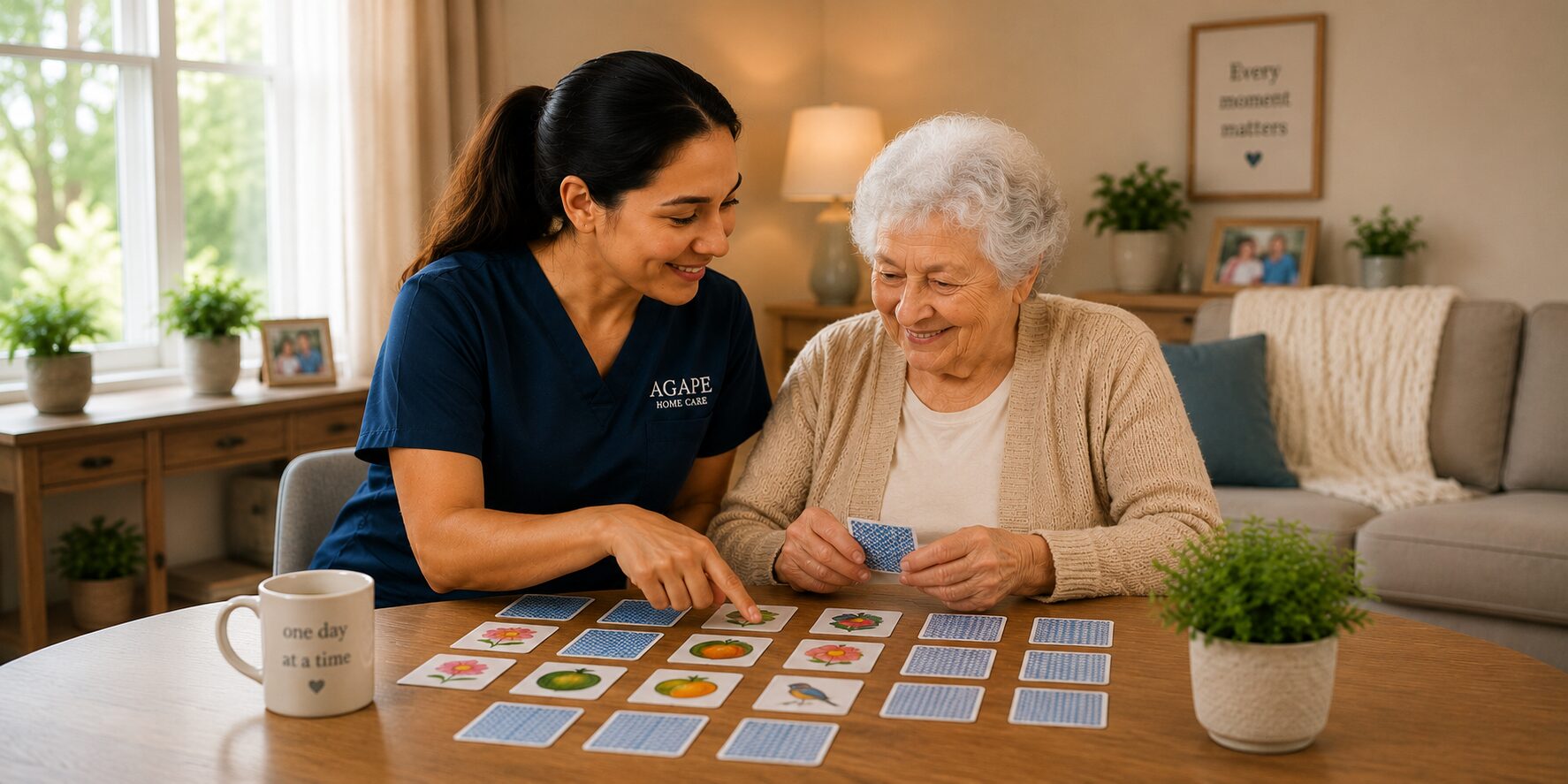
If your loved one has been diagnosed with Alzheimer’s or another form of dementia, one of the first questions families ask us is: “Should we keep them home, or is it time to look at a memory care facility?” Our honest answer, based on 14+ years of experience: most families can — and do — keep their loved one home far longer than they think possible. And when the time does come for a facility, Agape is often still part of the picture.
This article is our honest take on how families navigate this decision — and why in-home care is almost always the right first chapter.
Why Home Is Almost Always the Right Starting Point
For someone living with dementia, the familiar environment of home is not just a preference — it’s clinically meaningful. Knowing where the bathroom is without having to think about it. Recognizing the smell of home. Seeing family photos on the walls. These things reduce confusion and agitation in real, measurable ways.
In-home care also means one dedicated caregiver with one client — an attention ratio that no facility can match. At Agape, our caregivers are trained specifically in dementia care: behavioral redirection, de-escalation, maintaining dignity during personal care. This is skilled, specialized work — not just companionship.
What In-Home Dementia Care Looks Like With Agape
- Personal care — bathing, dressing, grooming, toileting, all approached with patience and dignity
- Behavioral support — redirection for repetitive questions, gentle de-escalation during agitation, sundowning management
- Supervision and safety — monitoring for wandering risk, fall prevention, medication reminders
- Routine maintenance — meals prepared according to preferences, familiar daily schedules preserved
- Family support — regular updates, flexible scheduling, coverage from a few hours to 24/7 around-the-clock
When Families Choose a Memory Care Facility
Many families reach a point — after months or years of in-home care — where the level of need changes. Serious wandering risk, significant behavioral symptoms that are difficult to manage at home, or a family caregiver who has reached the limit of what they can sustain. When that happens, a memory care community may become part of the picture.
Moving to memory care is not giving up. For many families, it’s the decision that allows them to show up as a loving daughter or son again, rather than an exhausted caregiver. We respect that decision and we support it.
Important: Memory care facilities in Orange County typically run $5,000–$9,000 per month, and most is private pay. In-home care allows families to manage costs based on actual hours needed — starting with just a few hours a day and expanding as needs grow.
Agape Inside Memory Care Facilities
Here’s something many families don’t know: even after a loved one moves into a memory care community, Agape is often still part of their care.
Memory care facilities operate on staffing ratios — one caregiver for multiple residents. For residents with higher needs, more complex behaviors, or families who simply want more consistent one-on-one attention, we provide private duty caregivers who come into the facility and work alongside the facility’s staff.
This is a service we provide regularly throughout Orange County — in assisted living, memory care, and skilled nursing settings. Our caregiver is there for your loved one alone.
Questions That Help Families Think It Through
- Where is your loved one in their dementia journey? Early to moderate stages are typically the most natural fit for home-based care.
- What does your loved one express when they can? A preference to remain home deserves significant weight.
- What are the specific safety concerns? Fall risk, wandering, medication complexity — the answers shape the level of supervision required.
- What is the family’s capacity to coordinate? We can build around real schedules and real availability.
- Has the family considered a combination approach — home care now, with the option to add facility-based support later?
When a family calls us in the middle of this decision, we don’t push. We listen, ask questions, and help you understand what your specific situation actually requires — whether that’s home care, support inside a facility, or a combination of both.
Call us anytime at (949) 690-9990. We answer 24 hours a day — no voicemail, no call center. Just an honest conversation.
We’re Here to Help
Agape Home Care has served hundreds of families across Orange County for over 14 years. We answer our own phone — 24 hours a day, 7 days a week.
(949) 690-9990Request Free Assessment
✓ Licensed Home Care Organization
✓ All caregivers CDSS-registered
✓ Serving all of Orange County
✓ Same-day placement available